Posts

Royal Society Summer Science Exhibition

Image
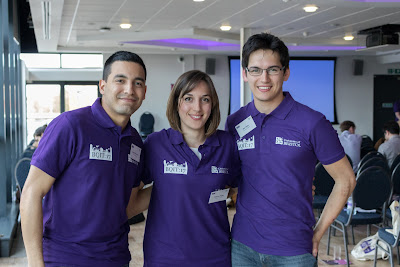
Researchers from CQP and QE-CDT manning the stand for the first half of the week The Royal Society Summer Science Exhibition is one of the largest events in the outreach calendar and is attended by thousands. Scientists from all over the UK are invited to display their cutting-edge research during the week-long event. After a competitive application process, the Centre for Quantum Photonics was invited to explain the weird and wonderful world of quantum computing, as one of only 22 exhibits. Team from the second half of the week enjoying the soirée Our exhibit took the public on journey to discover how we control light, why we want to use it to create more powerful computers and how the strange world of quantum mechanics will get us there. The first part of the display illustrated how our technology relies on the same physical processes as superfast broadband, confining light using total internal reflection. A simulation of the "quantum Christmas tree" produced ...
QET Labs at Cheltenham Science Festival 2017

Image
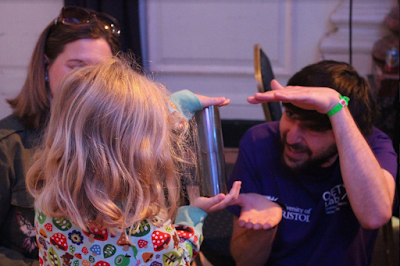
QETLabs researchers and PhD students showed the public demonstrations of optics and its use in encrypted communication systems (pictured above: Lawrence Rosenfeld). Cheltenham Science Festival is one of the UKs largest public engagement science exhibitions, which has had attendance of 45,000 visitors at previous events. This year’s festival saw researchers from QETLabs showcasing a variety of demonstrations. Organiser and researcher Henry Semenenko engaging a young scientist in message encryption Researcher Jake Kennard (left) and organiser and researcher Alasdair Price (right) ready to decode! QET Labs students and researchers Henry Semenenko and Alasdair Price organised demonstrations ranging from explaining the fundamental properties of light such as polarisation, and how we use it in sunglasses and 3D cinema glasses, to addressing current affairs of hacking encrypted messages and securing communications against malicious adversaries. Pictured: PhD student Be...

QET Labs at Bristol's Festival of Nature 2017

Image
Students from the Quantum Engineering CDT taught the public about light and colour at Bristol’s Festival of Nature this weekend. The CDT’s 3rd cohort, led by Cohort 1 student Euan Allen (pictured above), attended the event on Saturday and Sunday to demonstrate the effects of microstructures on colour in nature using butterfly wings, beetle shells, and several other naturally iridescent substances. The event, which attracts thousands to Bristol harbourside annually, aims to educate the public about nature, conservation, and the environment. Cohort 3 students (from left to right) João Diniz, Giorgos Eftaxias, Rachel Chadwick, George Atkinson, Jorge Ruz, and Ross Wakefield pose in front of their demonstration. Festival of Nature demo

Day 3 of the Bristol Quantum Information Technologies (BQIT) workshop

Image
Almut Beige (University of Leeds) and her talk "from optical cavities to cavity-fibre networks" BQIT:17's third and final day saw the workshop draw to a close with another sunny day of talks on detectors, hybrid platforms and integrated photonics. Kicking things off was Sae Woo Nam from NIST. Sae Woo explained two projects around the subject of superconducting nanowire single photon detectors (SNSPDs): one which showed a detection efficiency when used in practice of over 93%, and another on SNSPDs integrated into waveguides. He finished talking about some work with Dave Wineland integrating these detectors with ion traps. University of Münster's Wolfram Pernice followed this by speaking about developing SNSPDs which are capable of detecting single photons in plane, making them suitable for waveguides. The first solid state & hybrid systems session began with Almut Beige from the University of Leeds, who explained how we can better understand how to couple...

Day 2 of the Bristol Quantum Information Technologies (BQIT) workshop

Image
Our BQIT student helpers (left to right) Jorge Monroy Ruz, Caterina Vigliar and Ben Slater Day 2 of QET Labs' fourth annual Bristol Quantum Information Technologies (BQIT) saw another sunny day of talks related to quantum technologies. The quantum information theory stream kicked off with the University of Bristol's Ashley Montanaro, detailing two recent algorithms to provide quadratic speedups for backtracking and Monte Carlo methods. This was followed by Ulm University's Martin Plenio, who talked about efficient ways of performing quantum state tomography, resulting in being able to experimentally demonstrate efficient state tomography for 20 trapped ions. Laura Mancinska, also of the University of Bristol, concluded this topic with a talk on how to verify that a state you are given is entangled. A coffee break precluded Winfried Hensinger of the University of Sussex, who began the scaling up theme by explaining the background of ion trap quantum computing, befor...

Day 1 of the Bristol Quantum Information Technologies (BQIT) workshop

Image
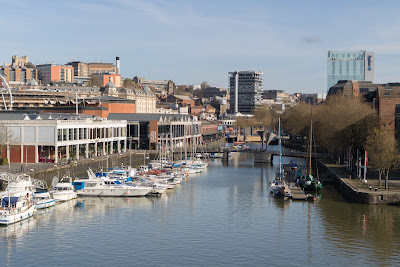
This year's BQIT workshop was hosted at the M Shed on Bristol's harbourside. The first day of QET Labs' fourth annual Bristol Quantum Information Technologies (BQIT) Workshop kicked off with a whistle-stop tour of quantum technologies, ranging from the foundations of entanglement to the quantum industry. For entanglement foundations, first to speak was University of Toronto's Aephraim Steinberg, highlighting two recent results: how quantum-enhanced sensing can beat "Rayleigh's curse" and strongly increase nonlinear optical effects. He was followed by Marek Żukowski from the University of Gdańsk, who explained how redefining Stokes parameters can lead to better entanglement observations. The devices segment began with Josh Nunn from the University of Oxford unveiling a long awaited result: A noise free quantum memory! University of Pavia's Marco Liscidini followed this with his proposal for a ring resonator with 99.9% purity. Our first inform...

Bristol Optical Student's Society (BOSS) and QETLabs researchers show off the power of optical fibres and photonic crystals to local school children at the new UnitDX facility, Bristol's new science incubator.

Image
This time, the very first members of the public visiting UnitDX's sparkling new laboratories were neither local officials nor scientists, but children from local schools coming to discover how science will be used to engineer their futures. Arriving two days before the official opening of the site, the children had the opportunity explore a number of different exhibits, from donning VR headsets to interactive play with molecules, to lab coats for chromatography.  At the event, students from Bristol Optical Students Society (BOSS) and QETLabs presented demonstrations of the fundamental concepts underpinning the cutting-edge research of the University of Bristol quantum photonics group. Their first demo displayed the apparent "magic" of optical fibres, completely trapping light inside without the need of a single mirror. By creating optical fibres of water, the students saw how light can be bent around corners and how this is used in fibre broadband to create super fa...